
Category: Tutorial
-

An Introduction to Signal Smoothing
—
Noise is everywhere. Whether you’re sampling accelerometer data for a mobile game or trying to measure the temperature of a room, noise will be there. Even if you could remove all the noise from an input device, you’ll still have a certain degree of uncertainty. If a player has tapped on the screen, where did…
-
Generating Deep Dreams
—
The previous post in this series, Understanding Deep Dreams, explained what deep dreams are, and what they can be used for. In this second post you’ll learn how to create them, with a step by step guide.
-

Understanding Deep Dreams
—
In the last few months the Internet has been flooded with deep dreams: images augmented by neural networks which look incredibly trippy. Deep dreams have the potential to become the new fractals; beautifully backgrounds everyone knows are related to Maths, but no one knows really how. What are deep dreams, how are they generated and what can they teach us?
-

The Top 5 Easter Eggs in Python
—
Despite being a very serious language, Python is full of Easter eggs and hidden references. This post shows the top 5: I have covered the 5 most interesting features of Python in this post.
-
-
LCD Monitor Shader Effect
This tutorial will show how to create a realistic shader that simulate the look and feeling of LCDs (Liquid Crystal Displays). Developer Monomi Park has recently announced (link) a new update to their game Slime Rancher. One of the most intriguing cosmetic effect that is going to be added is a special LCD shader that makes…
-
Evolutionary Computation – Part 4
—
Our journey to harness the power of evolution is coming to an end. In the previous three parts of this tutorial we have constructed a bipedal body and a mutable genome that determines its behaviour. What’s left now is to actually implement the evolutionary computation that will find a successful walking strategy.
-

Evolutionary Computation – Part 3
—
When we are looking at a problem through the lens of evolution, we always have to take into account its two faces: the phenotype and genotype. The previous post focused on creating the body of the creature, together with its brain. It is now time to focus on the genotype, which is the way such information is represented, transmitted…
-
Evolutionary Computation – Part 2
—
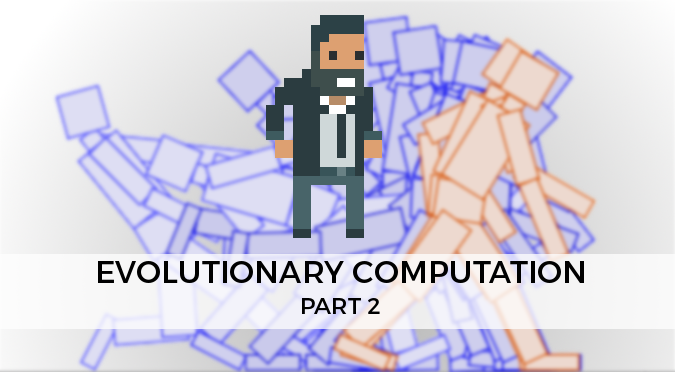
In the first part of this tutorial we have explored what evolutionary computation is, and why it works. The rest of this tutorial will show how to set up a practical example and how to use evolution to solve a real problem. In our case, the problem is teaching a bipedal creature how to keep balance and how to walk…
-

Evolutionary Computation – Part 1
—
This series of tutorial is about evolutionary computation: what it is, how it works and how to implement it in your projects and games. At the end of this series you’ll be able to harness the power of evolution to find the solution to problems you have no idea how to solve. As a toy example, this tutorial will show…