
If the name of this post is somehow scaring you… good! It means that it works! This post is a postmortem report of “RAPTUS” (stylised as “ЯAP†US“), my first flash game completely built in Flixel 2.5. If you didn’t play the game yet – shame on you! – do it now, because this post will spoil you everything and more!
The inspiration: “The Body”
The story behind “ЯAP†US” is inspired mainly by “The Body“, a very short game created by Beans M.. The main character of “The body” has to bear the body of the wife he murdered, walking through a forest as well as through his memories. Despite its author claims himself as “not particularly proud of“, I really liked the concept and I thought to extend it to a longer and more playable version.

It wasn’t easy to find a soundtrack that would have been as effective as the one used on “The Body” is. After some [failed] experiments, I decided to use “Past Present Future” composed by Oliver Tank. The music itself is neither depressing nor dark, but after putting some synchronisation effects into the game, it worked great!
The game contains a small citation from “Where the wild roses grow”. The theme of the song inspired part of the dialogues, especially the ones in Chapter III.
The gameplay: “Pathos”
The gameplay of “Raptus” has been inspired by “Pathos“, “a slow, experimental game that follows the story of a boy plunged into an unfamiliar world“. What I liked about “Pathos” is the constant frustration that the player experiences during the entire game. A frustration that, of course, is intended.
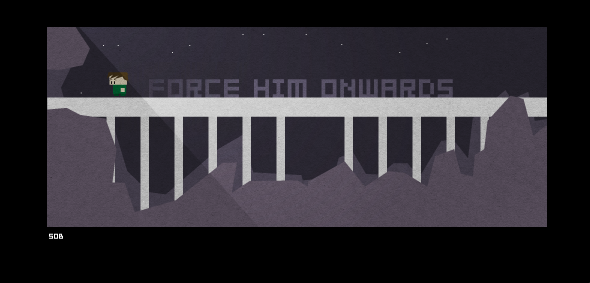
Another interesting aspect of that game is that it slowly “forces you into being evil“. You start thinking of controlling and helping the little boy, but actually you lead him towards his doom. With “RAPTUS” I tried to achieve the same feeling. The initial dialogues make the player think that the main character is going to commit suicide because of a broken heart. With every action you give him “the strength to carry on” only with the purpose of bringing him into a deeper desperation. The final scene of Chapter II suggested that your girlfriend could be evil, and it is unclear if the shadow is chasing you, or is following her.
Sash MacKinnon, the developer of “Pathos”, commented the beta version of “Raptus” saying:
I felt the emotional journey was almost the opposite of “Pathos”. Both “Pathos” and “Raptus” were about self loathing, but in “Raptus” the emotional spike was during the game. “Pathos” it was afterwards. “Raptus” gave you a sense of vengeance when you could kill the character at the end, because he made you hate yourself. “Pathos” gave you a sense of empathy when you had to kill the character at the end, because he was innocent.
The philosophy: the trivialisation of the Death
Even if “RAPTUS” hardly lasts for more than seven minutes, almost every detail it contains has a meaning. For the entire game, it is possible to “bend” the main character’s will simply with a click. In the very end, he finally becomes aware of the player’s influence (or it always was?) and decides not to being manipulated anymore. The default controller becomes the keyboard, however the player is still the one who controls the main character. Free Will is an illusion, indeed.
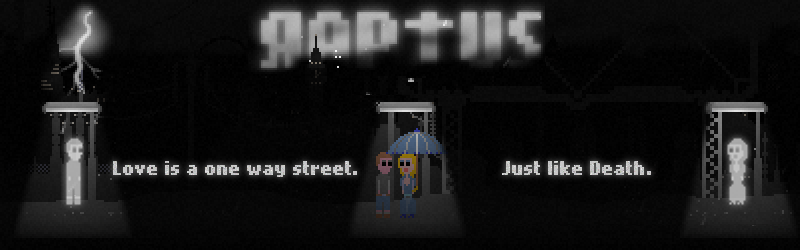
There are other several game aspects with an interesting meaning. During one of the first scene, for example, the main character says that “Love is a one-way street. Just like Death.“, and in that moment the car starts running on an endless street that will eventually lead him to death.
When I was looking for a sponsorship, I can’t deny that I was quite worried. In several games you use to kill hundreds (or thousands!) of people just in few clicks, but when the player is forced to think about his own actions, then it becomes an uncomfortable topic. Christopher Rozek, from the staff of “Flash Game License” said:
I’m afraid that the game is just not appropriate for us due to the focus on rape and murder.
The fact that it is so well crafted is what makes it feel in appropriate.
The problem of “RAPTUS” is not the fact that is based on “murder”, but that it challenges the trivialisation of the death that makes us – all of us – feel so safe.
 Become a member